In the high-stakes environment of construction, industrial logistics, and commercial project management, a 40ft storage container is far more than a steel box. It is a foundational asset for site security, inventory management, and operational flow. As supply chains remain complex and material costs stay high, the margin for error in on-site storage has narrowed. A single oversight in site leveling or a misunderstanding of container dimensions can lead to damaged inventory, stolen equipment, or costly labor delays.
Whether your job site is navigating the high-altitude snows of Colorado, the coastal conditions of Southern California, or the intense heat of places like Arizona and Texas, understanding the technical requirements of these heavy-duty units is essential for protecting your bottom line.
This guide provides the technical depth required for project managers and business owners to optimize their 40ft storage strategy, ensuring a seamless delivery and a secure job site.
Decoding 40ft Specs: Standard vs. High Cube
When a site requires significant storage, the first decision is choosing the right height. While the footprint remains identical, that extra foot of vertical space in a High Cube (HC) unit is often the difference-maker for commercial and B2B applications.
The Standard 40ft Unit
-
Best For: Dense, heavy materials, palletized goods, floor tiles, and heavy machinery parts.
-
Internal Dimensions: 39’5” L x 7’8” W x 7’10” H.
-
The Logistical Setup: The standard height provides ample clearance for traditional forklift loading. It is the go-to choice for horizontal storage needs where maximum vertical stacking isn’t a priority.
The 40ft High Cube (HC)
-
Best For: Bulky inventory, tall equipment, and maximizing vertical storage without increasing the unit’s physical footprint on your site.
-
Internal Dimensions: 39’5” L x 7’8” W x 8’10” H.
-
The Advantage: The extra 12 inches of vertical clearance allows for double-stacking lightweight pallets or storing oversized materials safely.
For a granular breakdown of every inch, including exact door opening widths and external measurements, consult our comprehensive guide to container dimensions.

Construction Inventory Math: Maximizing the 300 Sq. Ft.
A 40ft container offers exactly 300 square feet of floor space. But what does that look like when you’re actually loading it up? To help your team visualize the capacity and avoid over-ordering, consider these verified B2B loadouts:
-
Volume and Pallet Efficiency: A standard 40ft unit provides 2,370 cubic feet of volume, which comfortably fits 18 standard US pallets (2 across and 9 deep) on the floor in a single tier. Upgrading to a High Cube increases your total volume to 2,670 cubic feet.
-
Sheet Goods and Building Materials: A 40ft shipping container can hold roughly 100 sheets of 4×8 plywood in a single flat stack and may still allow room for 20-foot rebar or PVC pipe plus a walking aisle, depending on how the material is staged.
-
Weight Limits: A standard 40ft unit has an empty weight of roughly 8,000 lbs, while the High Cube comes in around 8,500 lbs. Despite their empty weight, both units are engineered to handle massive payloads, boasting a maximum net load capacity of 60,000 lbs. This makes them ideal for housing heavy tools, bulk cement, and compact construction equipment.
40ft Storage Container Capacity Estimator
Calculate your loadout based on floor-space for pallets and vertical stacking for other materials.
These estimates are based on conservative job-site staging assumptions, including safe access lanes and limited vertical stacking. Actual fit may vary depending on bundle size, load weight, forklift access, retrieval order, and how tightly materials are packed. These estimates prioritizes safe access and staging, not maximum packing density.
Regional Expertise: Engineering for the Southwest
Operating across the Southwest means your storage fleet must be prepared for environmental extremes that vary wildly by location. At Southwest Mobile Storage, regional readiness is built into our deployment strategy.
-
Heat Mitigation: In the desert corridors of Arizona and Texas, internal container temperatures can soar during the summer months. This “oven effect” can ruin temperature-sensitive adhesives, paints, and the circuitry of expensive power tools. We provide solutions like reflective coatings and enhanced ventilation to maintain airflow and protect your high-value inventory.
-
Environmental Sealing: Whether facing the fine silt and dust storms of the desert plains or the coastal moisture in Southern California, environmental ingress is a major threat. Look for a container that is wind and watertight (WWT) to keep your items safe from a sudden monsoon or dense coastal fog.
-
Structural Integrity: In the Rockies and high-desert areas of Colorado, a 40ft roof span must be robust enough to handle the weight of significant snow. Selecting the right container grade is critical. Our container experts work directly with site managers to ensure that the rental units and premium containers deployed to these regions are structurally sound and fully capable of withstanding heavy seasonal weather.
Avoiding “Racking”: The Invisible Threat to Site Security
The most common problem reported on job sites isn’t a mechanical failure, it’s a door that simply won’t close. In many cases, this is caused by a structural issue known as Racking.
Because a 40ft container is so long, it is highly sensitive to the ground it sits on. So, if one corner of the container sits lower than the others, the rectangular steel frame will twist slightly. This racking pinches the door hinges, making it nearly impossible to operate the doors and lock up at the end of a shift.
Watch: To see racking in action and learn how to fix it in seconds, check out our video on How to Properly Open and Close Your 40ft Unit.
B2B Delivery and Site Prep Checklist
To prevent racking and ensure a smooth drop-off, review these site requirements before your unit arrives:
-
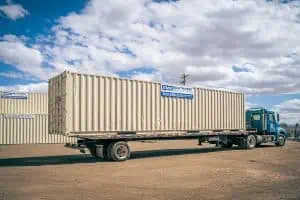
The 120-Foot Rule: Our tilt-bed delivery trucks require approximately 120 feet of straight-line clearance to safely unload a 40ft container. Ensure the pathway is completely clear of equipment, vehicles, and debris.
-
Surface Selection: Never place an 8,000-pound container directly on soft fill-dirt or fresh asphalt on a hot day. The extreme weight will cause the corner castings to sink, instantly leading to a racked frame.
-
The Foundation: Use compacted gravel pads, concrete footings, or heavy-duty railroad ties under the four corners. This keeps the unit off the ground and ensures the frame stays level.
-
The “Light Test”: Once the unit is delivered, step inside during the day and close the doors. If you see daylight peeking through the rubber door seals, the unit is likely racked and needs a corner shimmed.
For a comprehensive breakdown of site preparation, driver communication, and gate width requirements, read our Full Guide to Container Delivery and Site Prep.
Security and Risk Management
For a commercial project, the initial cost of a container is secondary to the security it provides. Construction sites are prime targets for theft, and standard padlocks are easily defeated by bolt cutters.
Our B2B storage units are equipped with factory-installed steel lock boxes. These thick steel housings completely shroud your padlock, creating a physical barrier against tampering and theft. Combined with sturdy plywood floors that are inspected for structural soundness and safe pallet-jack use, our units are designed from the ground up for heavy-duty commercial use.
The Southwest Mobile Storage Advantage
When you partner with Southwest Mobile Storage, you aren’t just getting a metal box. You are getting a site-ready solution engineered for your specific environment and load-out requirements. Whether you are setting up a multi-year staging area or a temporary materials hub, we provide the industrial-grade equipment and logistical expertise to ensure your storage works as hard as your crew does.
Download our Catalog
See all the documents we have available for you by clicking the button below:
Download PDF